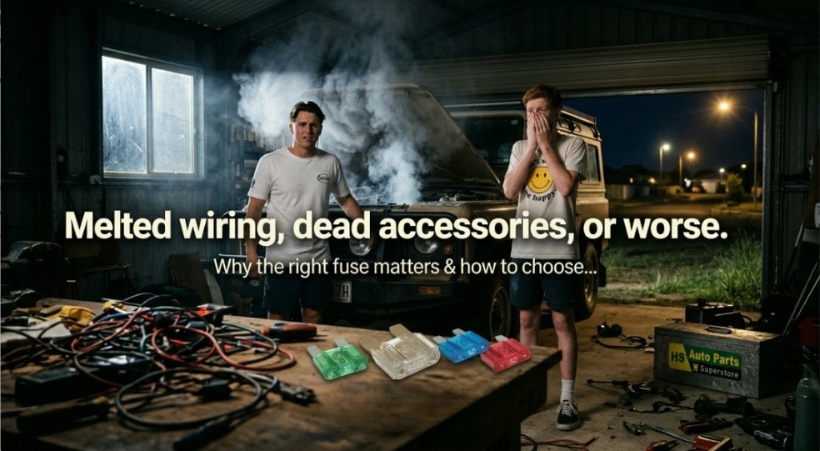
Automotive Fuses – Choosing the Right Protection for the Job
Let’s Take the Confusion Out of Fuses
“Using the wrong fuse is like using a bulldozer to chase butterflies — it might work… but it’s not going to end well.”
You don’t plough a paddock with a Ferrari…
and you don’t chase butterflies with a bulldozer.
Same deal with fuses.
Pick the wrong one, and best case it won’t work properly. Worst case — you’re chasing electrical faults, blowing circuits, or risking damage to your wiring.
Getting the right fuse for the job makes all the difference.
Why Fuses Matter
A fuse is there for one job — to protect your wiring and your gear.
If something goes wrong, the fuse sacrifices itself before your wiring melts, your accessories fail, or things get expensive real quick.
But here’s the catch…
Not all fuses are the same.
Different circuits, different loads, and different setups all require different fuse types and sizes.
The Common Fuse Types You’ll See
Mini Blade Fuses
Compact and common in modern vehicles.
Used in factory fuse boxes
Ideal for low-current accessory circuits
Often paired with fuse taps for clean installs
Standard Blade Fuses (ATO/ATC)
The old reliable.
Larger than mini fuses
Found in older vehicles and aftermarket installs
Easy to work with and widely available
Great for simple installs where you just need protection close to the power source.
MIDI Fuses
Stepping up into higher current setups.
Common in dual battery systems
Used for mid-range loads (chargers, DC-DC units, etc.)
Compact but capable of handling more current than blade fuses
A great middle ground between small accessory fuses and heavy-duty protection.
Maxi Fuses
When things start drawing serious power.
Larger blade-style fuse
Used for high-current circuits
Common in 4WD and touring setups
Ideal for protecting bigger accessory feeds and distribution circuits.
Mega Fuses
The heavy hitters.
Designed for very high current applications
Common on battery connections and main power feeds
Used in serious 12V systems and heavy-duty setups
This is your main line of defence when dealing with big power.
Choosing the Right Fuse
It’s not just about grabbing whatever fits.
You need to think about:
Current Load
What is the circuit actually drawing?
Undersized fuse = nuisance blowing
Oversized fuse = no protection (dangerous)
Location
Under bonnet → heat resistant, heavy-duty options
Inside cabin → compact blade fuses
Rear canopy → inline or fuse blocks for neat installs
Accessibility
Do you want everything in one spot?
Or individual protection spread through the vehicle?
This is where fuse blocks or grouped fuse holders make life much easier — especially in canopies and touring setups.
Workshop Tip (From Experience)
We see it all the time…
Wrong fuse type forced into holders
Oversized fuses used “just to stop it blowing”
No fuse at all on accessory installs
That’s how you end up with melted wiring, dead accessories, or worse.
The Bottom Line
There’s no “one fuse fits all” solution.
Choosing the right fuse comes down to:
The circuit
The load
The install location
And how you want your system laid out
Get it right, and your setup is safe, reliable, and easy to service.
Get it wrong… and you’ll know about it pretty quickly.
Need the Right Fuse for Your Setup?
At HS Auto Parts, we stock a full range of:
Mini & standard blade fuses
Inline fuse holders
MIDI, Maxi & Mega fuses
Fuse taps and accessory wiring gear
All gear we use in the workshop — not just stuff that looks good on a shelf.